Scalars and Vectors
Scalars and vectors are two different ways of expressing a measurement or quantity. Vectors are important in electricity because many electrical phenomena act in 3D space.
Scalars
Scalars are like ordinary numbers. They have only a value, and do not give (or need to have) information about direction. Examples of scalars:
- distance;
- area;
- volume;
- speed;
- temperature;
- time;
- voltage;
- current;
- resistance;
- capacitance;
- force (when treated as a scalar)
- ***velocity is normally a vector, but is sometimes given as a scalar.
Magnitude is a stricter subset of values, where magnitude is always zero or a positive number. Some scalars are expressed using negative numbers e.g. Celsius temperature. These may be considered values along a number line.
Vectors
Vectors have both magnitude and direction information. In other words, vectors tell you not only what a quantity is, but where it is going. Some quantities are given different names as vectors. The corresponding scalar quantity is given in brackets.
Some examples of vectors are given below:
- displacement (vector form of distance);
- velocity (vector form of speed);
- electric field;
- magnetic field;
- force (when treated as a vector);
- current (when required in 3D space).
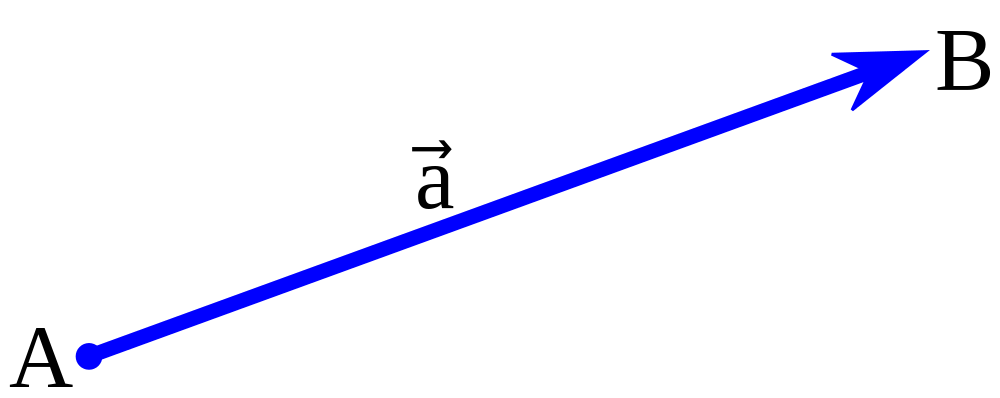
The image below shows a vector directed from point A to point B. The length of \( \vec{a} \) is the magnitude, and the orientation of \( \vec{a} \) is the direction. In this case, the vector \( \vec{a} \) is oriented from A to B.
Vectors are important in electricity because electrical phenomena act (and are acted on) in 3D space. A common application of this is writing the direction of current. Electric current is directed through a medium, and therefore can be though of as a vector. If the wires are perpendicular to the page, the symbols below are used.

The 'X' symbol means that current is flowing into the page away from you. The '.' symbol means that current is flowing out of the page away from you. This notation is important, as some electrical phenomena, such as forces between current-carrying conductors, take vector inputs (current and magnetic field), and output another vector (force). These effects are inherently 3D, as the resulting force vector is always at 90° to both magnetic field and current.